 |
deltaFlow
|
|
deltaFlow
|
Declaration of the Gauss-Seidel load flow solver for power system analysis. More...
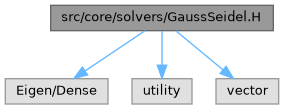
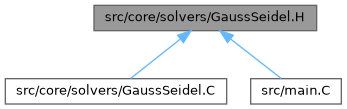
Go to the source code of this file.
Classes | |
| class | GaussSeidel |
| Gauss-Seidel power flow solver implementing the ISolver interface. More... | |
Declaration of the Gauss-Seidel load flow solver for power system analysis.
The Gauss-Seidel method is an iterative algorithm to solve the power flow equations for bus voltages in a power system. It uses the bus admittance matrix $$ Y_{bus} $$ and iteratively updates the bus voltages $$ V $$ to satisfy the power balance equations:
$$ S_i = V_i \sum_{j=1}^N Y_{ij}^* V_j^* $$
where:
The Gauss-Seidel voltage update for the k-th iteration is:
$$ V_i^{(k+1)} = \frac{1}{Y_{ii}} \left( \frac{S_i^*}{V_i^{*(k)}} - \sum_{j=1, j \neq i}^N Y_{ij} V_j^{(k+1 \text{ or } k)} \right) $$
For voltage-controlled buses (PV buses), the reactive power injection $$ Q_k $$ is unknown initially but can be computed at iteration i by:
$$ Q_k^{(i)} = V_k^{(i)} \sum_{n=1}^N |Y_{kn}| V_n^{(i)} \sin \left( \delta_k^{(i)} - \delta_n^{(i)} - \theta_{kn} \right) $$
The total reactive power generation at bus k is:
$$ Q_{Gk} = Q_k + Q_{Lk} $$
where $$( Q_{Lk} )$$ is the reactive load demand at the bus.
If the calculated $$( Q_{Gk} )$$ remains within its specified limits (e.g., $$ Q_{Gk}^{min} \leq Q_{Gk} \leq Q_{Gk}^{max} $$), the voltage magnitude $$ V_k $$ is fixed at its specified value, and only the voltage angle $$ \delta_k $$ is updated using the Gauss-Seidel formula. This means:
If $$( Q_{Gk} )$$ exceeds its limits during any iteration, the bus type is switched from voltage-controlled (PV) to load bus (PQ), with $$ Q_{Gk} $$ fixed at the violated limit (either $$ Q_{Gk}^{max} $$ or $$ Q_{Gk}^{min} $$). Under this condition, the voltage magnitude $$ V_k $$ is no longer fixed and is recalculated by the load flow program.
To accelerate convergence, a relaxation (or acceleration) coefficient $$ \omega $$ (typically $$(0 < \omega \leq 1) $$) can be applied to the voltage update:
$$ V_i^{(k+1)} = \omega \times V_i^{(k+1)} + (1 - \omega) \times V_i^{(k)} $$
The iteration proceeds until the maximum change in bus voltages between iterations is below a specified tolerance, or the maximum number of iterations is reached.
Definition in file GaussSeidel.H.
 1.9.8
1.9.8